From Zero to One:
The First Year of IYCEO
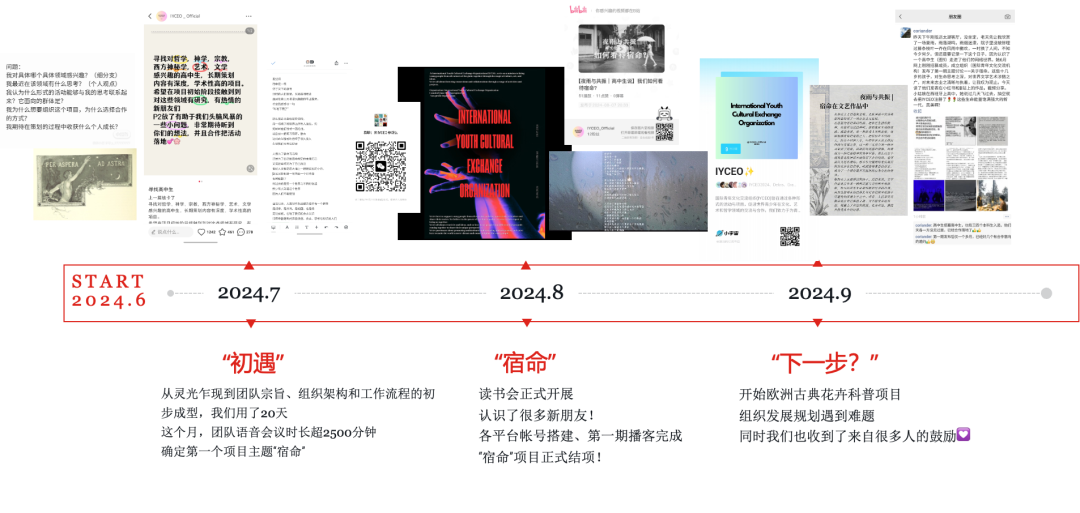
In the summer when I was seventeen, driven by a vague impulse to “do something different,” I posted an open call online, searching for kindred spirits. Since then, I’ve met more and more young people who share a passion for literature, philosophy, and art. We live in a digital age, yet there are so few spaces where people can truly express complex ideas or connect beyond the surface. Most platforms seem less interested in how young people think about and build culture, and more in how culture can guide them to produce or consume. That’s why I founded IYCEO, a nonprofit project built entirely from scratch and driven by a simple belief: young people deserve a place to think deeply, express freely, and connect across cultures.
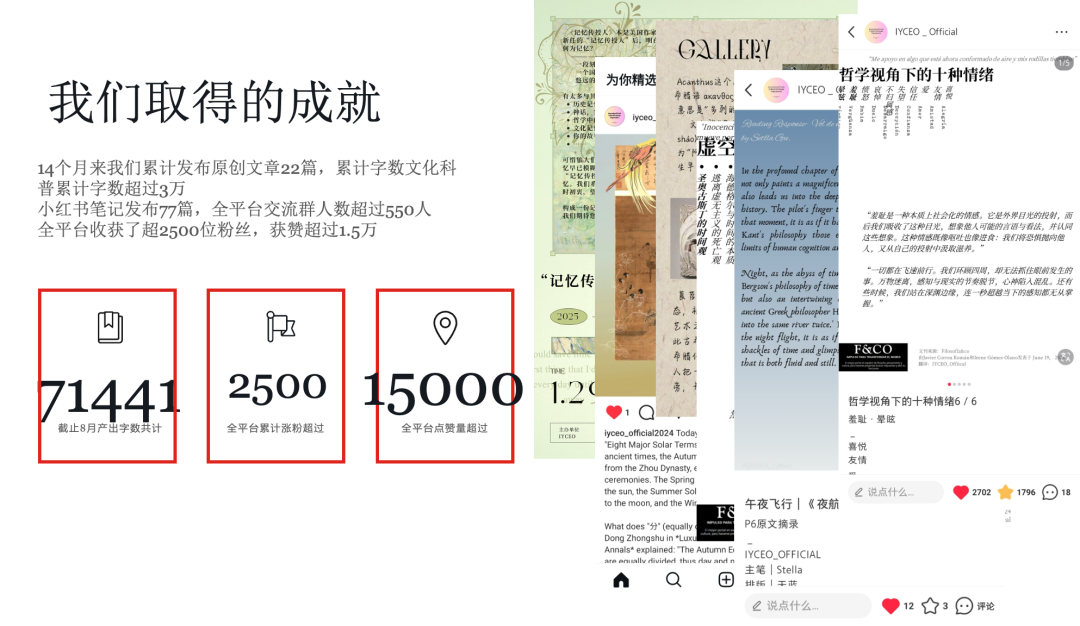
Over the past year, we’ve explored four themes that I believe are among the most universal and profound in human experience: fate, the metaphor of death, memory, and the act of calling and being heard. No matter where one lives or what circumstances they face, everyone has the right to reflect on these questions. Meanwhile, my teammates and I have continued our dialogues, translations, and cultural projects. To date, we’ve published over 71,000 words of original writing and reached more than 2,500 readers and friends. It takes courage to explore these shared yet deeply personal questions of human existence. Through questioning and introspection, you begin to discover which parts of yourself are the most genuine -- the parts that form the essence of your life. And somehow, on the vast internet, a place where “no one really knows anyone,” we’ve managed to meet and discuss topics so intimate and inward.
Where are the boundaries of culture? How does culture define you and me? Perhaps because there are no ready-made answers, we continue to explore and experiment. We often say that we are “powered by love,” and to me, this kind of love resembles the Spanish word inquietud — the restless desire to make life more interesting, a spiritual unease, and one of the most precious qualities of youth.
One year is only the beginning. In the years ahead, I hope to keep meeting more young people who share this inquietud, to keep expanding the boundaries of thought, and to try, in this fragmented and noisy age, to reconnect the invisible threads between human spirits.
— Tianlan
Suzhou, August 2025
Our Year
01.
Night Rain and Resonance — Why Fate?
Our first theme was fate. It’s an ancient word, yet one that everyone eventually faces. When we discuss fate, it’s not only a philosophical question but one that touches daily life: What is already written? What can be changed by our own hands? When we look back at our lives in quiet moments, do those small coincidences feel like inevitabilities in disguise? Fate isn’t a word meant to discourage — it invites us to rethink our relationship with the world.
02.
Death Metaphor:
Death Metaphor
The Unspeakable Ultimate Experience
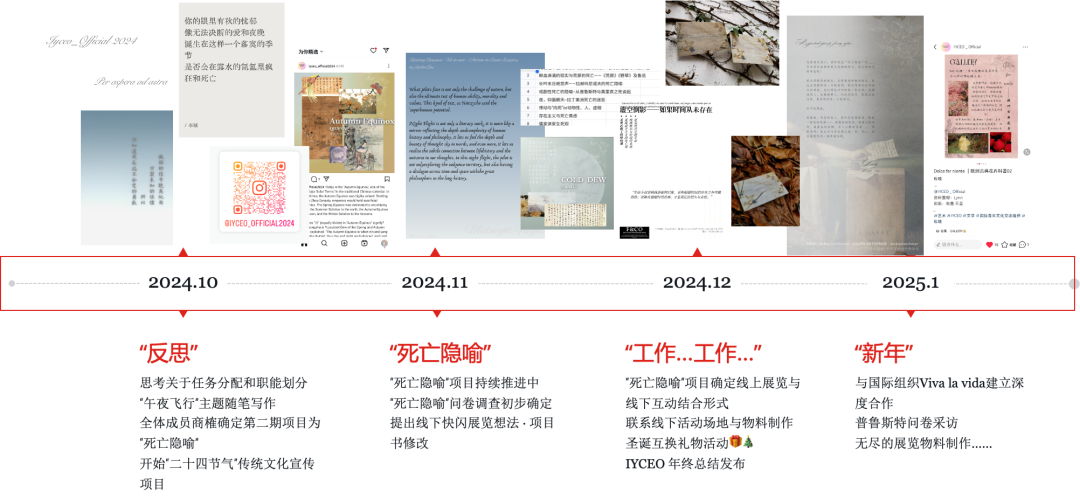
Death is often avoided as a topic, yet it is one of the most universal human experiences. We approached it through metaphor, because the death we understand is never just biological -- it is a symbol deeply embedded in culture. In our offline exhibition, we tried to experience death from a first-person perspective, questioning what it truly means: an ending, or a new beginning? Through our social research, we also observed how death seeps into language, rituals, and everyday customs, shaping collective consciousness in unseen ways. During this project, we partnered with VIVA to explore the relationship between life and death through the artistic form of “life portraits.”
03.
MEMORY | The Giver of Memory
In The Giver, Jonas flees while carrying all of humanity’s memories. Because memory is never a tame inheritance — it is a burning spark. It pierces through the orderly walls of utopia and illuminates the depths of individual existence. We gather here not to replicate the past, but to seek within the cracks: When myth loses its time, how does it whisper in our veins? When history is retold again and again, which scar remains its true shape? When one gazes at an old photograph, is one touching a vanished moment, or a self being reborn?
There is so much worth exploring through writing and imagination.
Historical memory and cultural identity, myth and collective remembrance, memory as a philosophical trace, and personal stories that form living archives. Travelers are often in a hurry, and when they finally pause at the platform to recall something, they find their memories already blurred. How many of these blurred fragments were once things we swore never to forget?
We hope that when the silver moonlight spills over the valleys, those on their journeys might take a quiet moment to look back at where they began — to rediscover the road they once took. What, after all, makes up the raw material of memory?
04.
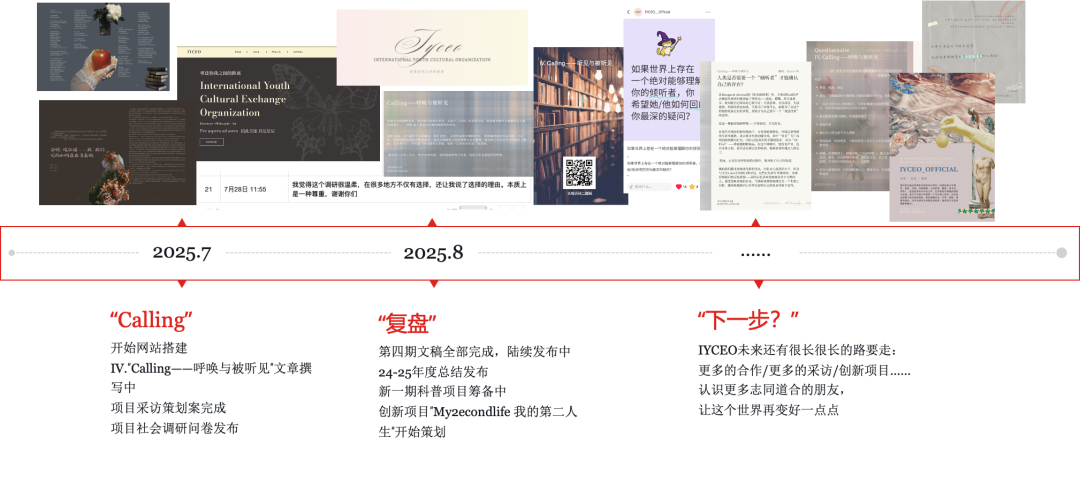
Calling: To Call and To Be Heard
From the silent prayers beside ancient campfires to the red handprints on cave walls; from Qu Yuan’scosmic questions in Heavenly Inquiriesto Cassandra’s ignored prophecies in Greek tragedy, calling has always been humanity’s most powerful expression of the soul.
We speak to seek certainty amid uncertainty; we long for an echo in the quiet. The manuscripts of the Mogao Caves slept for nine hundred years until the wind of 1900 blew open their hidden chamber.The graffiti on Pompeii’s walls,buried in volcanic ash, still moves archaeologists to tears two millennia later. And how many have wept for Li Yu’s lament, “How much sorrow can one have? As much as a river flowing east.”
The departed have waited long enough — but often, time itself circles back, picking up the calls that once went unanswered.
Our Words
Human beings live in a vast fog. You wave to others, nod in greeting, but no one can ever truly understand another. Death is when that fog suddenly thickens — you can no longer see others, and they can no longer see you. The final pulses of thought in your brain fade soundlessly into the wind. No one notices. And even if someone happens to catch them, they cannot be decoded. Human life is born beneath the shadow of death. Unless you send out a signal that the whole world can decipher, you never truly existed.
“Between the Crowd and the Fog: The Presence and Absence of Death”
But their tears fell on my shoulders and hands. In the heat and the boil of grief, I too dissolved into the crowd of mourners. The crying did not end with the burial; it began there. Amid the pain, a strange, detached fear crawled over my body: fear of the link between weeping and death, between death and pain. Even though I knew it was only the pain of separation, in that moment, death, in my eyes, was pain itself.
“I Awoke from the Night”
A gust of wind, and a tear falls into the dirt. The smoke scatters into hundreds of wisps — like the hundreds of joys and sorrows he once thought he had forgotten.
Collapse, fall, shadows fading — and someone is singing:
‘The garden once bloomed in brilliant color, now all is left to ruin. The fine spring day — whose courtyard now holds such joy?’
I wake with a start: a dream of a hundred years, the passing of time. Watching the human lights flicker outside the window, I let out a long sigh.
One fears remembering too much and turning to madness; another fears forgetting too much and turning to dust. Isn’t this human play we call life simply the endless pull between remembering and forgetting?
“The Lethe of the Human World”
Philosophy may never tell us whether someone is truly listening to our voices from the other side of the universe. But life and human instinct teach us a simple truth: We call out because we know we are not islands; We speak because we refuse to be swallowed by silence; We confess because, even in the ruins of meaning, we still want to keep a small space where we can be understood.
Perhaps that space will forever remain unreachable -- but precisely because of that, it is sacred.
“Do Humans Need a Listener to Confirm Their Existence?”


In the Future?
Among the many forms of expression through which we seek to be understood (for instance, in literature), which do you think matters more — thought or language?
Do prayers that receive no response still have meaning?
Does looking upward prevent us from truly seeing ourselves?
In my last high school philosophy class, my teacher wrote a personal letter to each of us. In mine, she mentioned a book — Días sin ti by Elvira Sastre, a novel about love, loss, and generational memory. She copied down a line for me: “Hagas lo que hagas, sigue el latido” — whatever you do, follow your heartbeat. When I read it, the tension of exam season vanished. All that remained was the reckless beauty and pulse of youth. Isn’t that what life should be — spontaneous and free?
But reality rarely allows such purity.
Amid the noise and confusion of the world, even when we know something may be impossible, do we still have the courage to ask ourselves what truly moves us? What makes our hearts beat faster?
……
If you could forget all practical concerns,
what would your second life look like at this very moment?